AI in Education: Insights from Campus Tech and Future Directions
by Anthony Law 2026-02-11
Inspiration from Forward-Thinking Campus Tech
Recently, by chance, I came into contact with an existing information technology system in a school, and its flexible response to the complex workflow on campus and forward-looking design gave me a lot of inspiration and reflection. In particular, the timetable management module within the system left a deep impression on me—the technical thinking behind it was ahead of its time, and even today, it still has valuable reference value. Such foresight is truly admirable.
This foresight also made me re-examine the design direction of the next generation of artificial intelligence (AI) applications in the field of education: instead of blindly following existing technical tools on the market, we should take the initiative to think about how to make AI exert more proactive value, allowing technology to truly serve the essence of education rather than becoming a follower driven by technology.
Core Principle: AI Assists, Not Replaces, Teachers
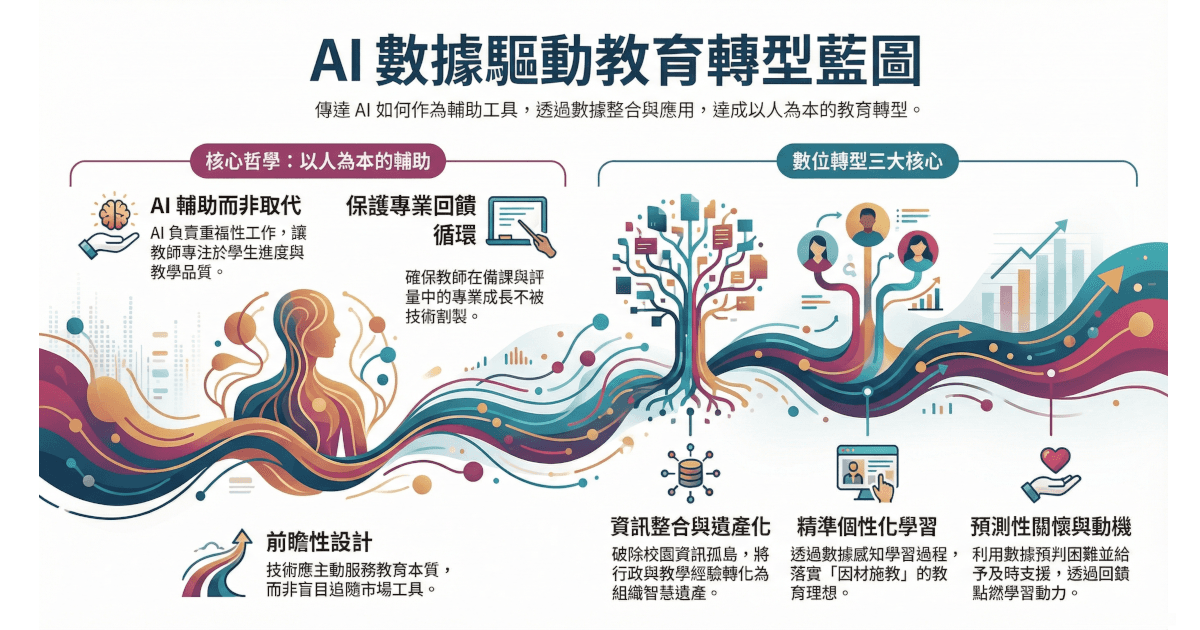
During the exchange, there was a core principle that I deeply agreed with: AI should assist teachers in teaching, not replace their core role in the educational field. This is a correct and indispensable direction both from the perspective of technical ethics and educational professionalism. Currently, generative AI still has an illusion problem and is not suitable as the final judge in the teaching process.
From the perspective of teacher professionalism, teaching is essentially a positive feedback loop—teachers should continuously deepen their professional capabilities in the processes of lesson preparation, grading, and teaching material design. Randomly using AI in teaching will break this positive feedback loop. In fact, the true value of AI in education lies in helping teachers reduce the burden of repetitive work and identify overlooked problems, enabling them to devote more time and energy to understanding students’ progress, adjusting teaching strategies, and truly improving the overall quality of teaching with the assistance of data and intelligence.
The Era of Data-Driven Digital Education Transformation
Today, the potential of AI and data science is no longer limited to simple content generation. We are gradually entering a digital education era centered on data, and through technological integration and data application, campus education is expected to achieve a comprehensive transformation, which can be promoted in the following specific aspects.
1. Campus Information Integration: Breaking Barriers and Unlocking Intelligent Value
In campus operations, various types of information related to teaching, administration, and culture should be important resources supporting the high-quality development of education. However, in the traditional model, such information is often stored separately and operates independently, making it difficult to form a joint force and even becoming an "information barrier" that hinders efficiency improvement. This makes us think: is the value of campus information lies in storage, or in being effectively utilized?
In fact, one of the core directions of campus digital transformation is to achieve global integration and intelligent evolution of information. Through an appropriate technical architecture, integrating scattered teaching knowledge, administrative experience, and campus cultural memories into an organic whole can not only solve the problem of experience loss caused by personnel turnover and ensure the continuity of educational inheritance, but also allow information to upgrade itself in the process of precipitation, becoming the "intellectual heritage" for the long-term development of the organization. This integration thinking is not only applicable to campuses, but also provides valuable transformation enlightenment for all organizations that rely on experience and information.
2. Data-Driven Decision-Making: Optimizing Workflows First
In the past, educational decisions mostly relied on experience and intuition. Not only were the judgments on students’ learning status and teaching effects relatively macro, but the more core problem was that the existing workflow lacked a systematic data collection and sorting mechanism, making it difficult to provide solid support for scientific decision-making. In fact, the key premise of AI-assisted educational decision-making is to first revise the existing workflow—only by optimizing the workflow and clarifying the standards and links of data collection can we obtain true and effective data.
Then, through the in-depth integration of data technology and the education field, a more refined and objective decision-making model can be formed. This is not a simple technical superposition, but a rethinking of "how to scientifically understand educational laws through process optimization and data empowerment." It is worth emphasizing that the value of data and AI is always based on reasonable processes and effective data, and its core is to assist rather than dominate educational decision-making. If we ignore the revision of the existing workflow and blindly apply AI based on scattered and non-standard data, it will not only be difficult to exert the value of technology, but may also lead to decision-making deviations.
3. Personalized Learning: Returning to "Teaching Students in Accordance with Their Aptitude"
Every student is an independent individual with different learning rhythms and potentials, and "teaching students in accordance with their aptitude" has always been the ideal pursuit of education. In the digital age, the value of technology lies in providing a more feasible path for the realization of this ideal—no longer an unattainable educational vision, but an educational model that can be gradually practiced.
Through the refined perception and analysis of the learning process, every student can clearly understand their own learning status and find a suitable direction for progress. This not only prevents students who are temporarily in difficulty from getting lost, but also does not limit students with outstanding potential. Behind this is a deep interpretation of the educational philosophy of "student-centered": when technology can truly meet everyone’s needs, education can move from "standardization" to "personalization". And how should we make technology better serve the growth of every unique life?
4. Gamified Learning: Using Data to Ignite Internal Motivation
Internal motivation for learning is the most precious asset of education. As an effective way to arouse motivation, gamified learning’s core is never the "game" itself, but the optimization of learning experience and the attention to students’ sense of accomplishment—this process is inseparable from solid data support and a deep understanding of educational psychology.
Data can help us better capture the details of students’ growth, identify their efforts and gains, and give affirmation and support in appropriate ways, turning learning from "passive acceptance" to "active exploration". This makes us think: what should a truly effective learning experience be like? When technology can accurately match students’ growth rhythm and ignite their enthusiasm for learning with positive feedback, education can get rid of the label of "boring" and become a fulfilling thing.
5. Predictive Care: Technology with Warmth for Student Growth
The essence of education is warm companionship and timely support. In the digital age, technology can not only improve efficiency and optimize experience, but also endow education with a "forward-looking nature"—through the subtle insight into students’ behaviors and states, we can identify the difficulties they may face in advance, take the initiative to give care and help, and make education move from "post-event compensation" to "pre-event prevention".
The core of this predictive care is never the accuracy of technology, but the respect and responsibility for every student—technology is just a tool, and behind it is the educators’ original intention of "not giving up on anyone". This makes us deeply reflect: when technology has "warmth" and when education can take the initiative to approach students, we can truly achieve the educational goal of "every life can be seen and supported", which is also the highest value of technology serving education.
Conclusion: Our AI Education Platform and Future Outlook
In summary, what AI and data science bring to school education is not only the upgrading of tools, but also a comprehensive evolution from teaching processes, learning experiences to management models—from breaking information barriers and releasing the value of intelligence, to data-driven scientific decision-making; from practicing personalized learning that teaches students in accordance with their aptitude, to using gamified design to arouse learning motivation, and then to guarding students’ growth with predictive care. The core orientation of this series of applications is always to let technology serve the essence of education, assist teachers and achieve students.
Based on these in-depth reflections and educational concepts, our company is currently developing an AI education platform, hoping to transform the above thinking into a implementable and promotable practical solution. This AI education platform developed by our company will fully integrate all the core concepts mentioned earlier, focus on the real needs of the education field, and strive to make technology truly enter campuses and get close to teaching.
When the platform has a preliminary application prototype, we also look forward to combining the actual scenarios of the campus, soliciting suggestions from all insightful people, and jointly exploring how to make this platform more in line with teaching practices and exert maximum benefits. Furthermore, we hope to promote in-depth dialogue and substantive progress in the next stage of educational technology, so that the value of AI and data science can be more fully released in the field of education.
Prev Post: The AI Divide: Hong Kong's Digital Transformation at a Crossroads
About Us
CODE IS PLAY is a team of experienced software developers. We build high quality code that persists.
Links
Other Services
TVP Funding
Digital Transformation
Technical Training
Contact Us
Address: Room A, 19/F, Max Share Centre, 367-373 King's Road, North Point, Hong Kong
Tel: (852) 92622251
Email: info@codeisplay.ai
Copyright © 2024 All rights Reserved by CODE IS PLAY. Privacy Policy